Who Supplies Parts for Saudi Arabia's First Car? Price Is Not the First Condition

Who Supplies Parts for Saudi Arabia's First Car? Price Is Not the First Condition
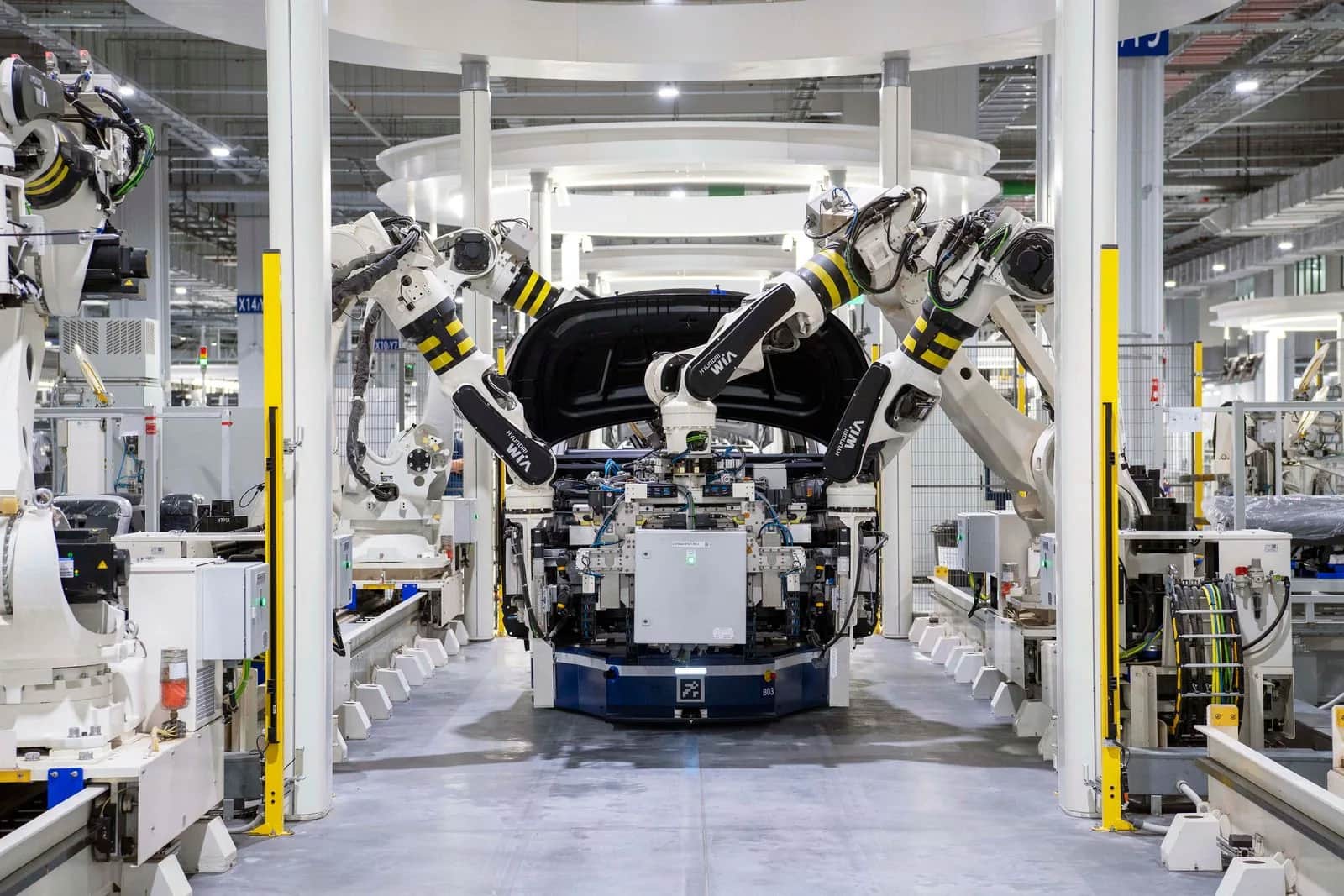
His Royal Highness the Crown Prince launched the first vehicles from Ceer, the national automotive company, on Monday under the name Exobot, in sedan and SUV variants, built at the Ceer industrial complex inside the King Salman Automotive Cluster in King Abdullah Economic City. The two variants are the first of seven models scheduled to roll out over the next five years. Ceer itself was established by the Public Investment Fund in 2022 as the first Saudi company dedicated to manufacturing electric vehicles.
So far this is an industrial story. But behind every car that leaves an assembly line sit hundreds of companies nobody reads about: who supplies the seats, who forms the metal parts, who moves components on a daily schedule that tolerates no delay, who makes the packaging, who runs maintenance and support services. That chain is being built right now. And the practical question for a factory owner, a workshop, or a logistics company in the Kingdom is not whether an opportunity exists, but what makes your company eligible to enter it.
Contracts in this sector are long, which is why the terms are different
In June 2024 Ceer signed an agreement with Hyundai Transys worth SAR 8.2 billion to supply integrated electric drive systems, running for ten years. The number is striking, but the duration matters more. The automotive industry does not run on seasonal contracts or scattered purchase orders. It runs on agreements that stretch across the full life cycle of a model.
That changes the question the buyer is actually asking. When a company buys from you once, it asks about price and specification. When it commits to you for ten years, it asks something else: can you deliver the same quality in month eighty as you did in month one, and can you prove it with records rather than assurances. That distinction eliminates most suppliers before price negotiation even begins.
Four things an industrial buyer asks before it asks about price
Requirements vary between sectors, but the qualification logic in heavy manufacturing is close to universal:
- Traceability from batch to shipment. If a defect surfaces in a component a year later, you need to answer one question within hours: which production batch, which raw materials, which shipments went out from it and where. A supplier without serialized batch numbering cannot answer, and a slow answer means recalling the entire product instead of a single batch.
- A delivery date that is measured, not promised. Assembly lines run on receiving windows defined by the hour. So a supplier is judged on its on-time delivery rate across a period, not on a general impression of reliability. If you are not measuring that rate today, you do not know your own number when the buyer asks for it.
- A quality record you can retrieve. The globally recognized quality management standard in the automotive sector is IATF 16949, and its substance is not a certificate on the wall but consistent documentation of inspections, deviations and corrective actions. A record that cannot be pulled on request is treated as one that does not exist.
- System-to-system links instead of messages. Purchase orders, shipment notices and invoices move between systems, not through files filled in by hand and emailed. On the local compliance side, phase two of e-invoicing at the Zakat, Tax and Customs Authority is built on connecting your system to the Fatoora platform, so a business that genuinely complies has already covered part of the distance.
Where Saudi companies usually break
In most cases we see, the problem is neither product quality nor manufacturing capability. The product is good and the team knows its work. The break happens in the layer above the product: inventory lives in a spreadsheet one person updates, batch numbers are written by hand on paper that stays in the workshop, invoices are issued at month end from a record separate from inventory, and nobody knows last quarter's on-time delivery rate because it was never measured.
Such a company is fully capable of manufacturing, and entirely unable to prove that it is. The gap between those two states is literally the gap between entering a supplier list and dropping off it at the first review. An industrial buyer does not reject you for being small. It rejects you because you cannot show it what you did last week.
The Origami view
We read today's launch as a timing signal more than a car story. The companies that will enter this chain over the next two years are the ones building their systems now, not the ones that start when a qualification request arrives with a thirty-day deadline. Building traceability, a quality record and delivery measurement takes months, and none of it can be assembled retroactively, because the historical data the buyer asks for simply will not exist.
The encouraging part is that these systems are not reserved for large factories and do not require a heavy budget. A workshop with thirty employees can run serialized batch numbering, barcode-based inventory and a dashboard that measures on-time delivery, and tie all of it to the e-invoicing it already has to comply with. The investment here is not aimed at one prospective customer. It reshapes how you run the plant whether or not you ever join the chain.
A practical conclusion
Do not start by asking how to apply as a supplier. Start with three questions about your own company: can I trace any product that left my premises back to its batch and materials within hours? What was my on-time delivery rate last quarter, as a number? And do my invoices and my inventory come out of one system or two separate records? If your answer to any of them is unclear, that is your starting point, and it comes before any conversation about a supply opportunity. Opportunities in this sector are rarely lost on price. They are lost on the inability to prove.
Sources
- Public Investment Fund — establishment of Ceer as the first Saudi company dedicated to electric vehicle manufacturing, and the naming of the King Salman Automotive Cluster for the automotive manufacturing zone in King Abdullah Economic City.
- Ceer Newsroom — SAR 8.2 billion agreement with Hyundai Transys for integrated electric vehicle drive systems, signed in June 2024 for a ten-year term.
- Saudi Press Agency — the Crown Prince launching the first Ceer vehicles under the name Exobot in sedan and SUV variants on September 21, 2026, the first two of seven models over five years.
- Zakat, Tax and Customs Authority — phase two of e-invoicing and the integration it requires between business systems and the Fatoora platform.
- IATF Global Oversight — the IATF 16949 automotive quality management standard and its documentation requirements.
Frequently asked questions
My company is small. Is supplying a car factory realistic at all?+
Yes, though not necessarily as a direct supplier to the assembly line. Automotive chains work in tiers: a tier one supplier delivers complete systems, below it sit suppliers feeding it components and services, and around the plant there is a whole layer of transport, packaging, maintenance and support services. The realistic door for a mid-sized business is usually the second tier or the surrounding services, where qualification terms are lighter but of the same kind: traceability, records, and delivery discipline.
What is the difference between a quality certificate and the quality record you describe?+
A certificate proves your system was audited at a point in time. A record proves what you actually did every day since. An industrial buyer wants both, but the one that eliminates suppliers in practice is the second: you are asked for inspection results on a batch delivered eight months ago and cannot produce them, or you produce them from paper logs with no link to the shipment number. A record that cannot be retrieved within hours is treated as one that does not exist.
How long does it take a mid-sized business to meet these requirements?+
The technical part is faster than most expect: serialized batch numbering, barcode inventory and linking invoicing to stock can be running within weeks. The slower part is accumulating historical data, because an on-time delivery rate and a deviation log mean nothing without a sufficient measurement period. That is exactly why delay is expensive: you can install the system quickly, but you cannot recover the months in which you measured nothing.
Does e-invoicing really have anything to do with supplier qualification?+
The link is indirect but real. Phase two of e-invoicing forces your invoices out of a manual file and into a system connected to the Zakat, Tax and Customs Authority platform, which means you already have a system that knows what you sold, to whom, and when, in a structured form. An industrial buyer builds on that same layer when it asks you to match a purchase order to a shipment notice to an invoice. A business that complies in substance rather than in form has already covered part of the distance.
Follow Origami in Google
Pin Origami as a preferred source and our articles will surface first for you in Google Search and Top Stories.
Related articles
- Business SystemsFleet Management and Vehicle Tracking Systems: A Practical Guide for Saudi BusinessesHow to turn your vehicles from an unexplained cost line into a measured operation: tracking, Wasl compliance, preventive maintenance, and integration with your systems.
- Business SystemsHR and Payroll Systems for Saudi Businesses: What You Actually Need and How to ChooseA practical guide to choosing an HR and payroll system in Saudi Arabia: what it must cover, how it connects to Mudad, GOSI and Qiwa, and when custom beats off-the-shelf.
- Business SystemsThe Rodri Transfer Lesson: Why Performance Does Not Move With the Asset You BuyBarcelona are closing in on Rodri, and the question occupying analysts is the same one facing every manager who buys the best system on the market or hires the strongest candidate: does performance travel with the asset, or is it a property of the system that produced it? A technical and managerial read of a deal that is not done yet.
- Business SystemsField Service Management Software: Run Technicians and Work Orders From One PlaceA practical guide for Saudi maintenance and service companies: what field service management software is, when you need it, its core modules, and how to connect it to e-invoicing.
- Business SystemsKnowledge Management: Why It's Your Company's Most Valuable Asset — and How to Stop It LeakingKnowledge is your company's most valuable asset, yet the only one that walks out the door every evening. Knowledge management keeps your company's expertise available to your team instead of trapped in people's heads — and with AI it's more powerful than ever. A practical guide for business owners.
- Business SystemsCRM Systems for Saudi Businesses: A Guide to Choosing the Right Customer PlatformA practical guide for Saudi business owners: what a CRM is, the signs you truly need one, how it differs from ERP, and how to choose the right system without overpaying.
Have a project in mind?
We build custom systems, apps and websites for your business. Tell us your idea and we will give you a straight answer on it.
