In this article

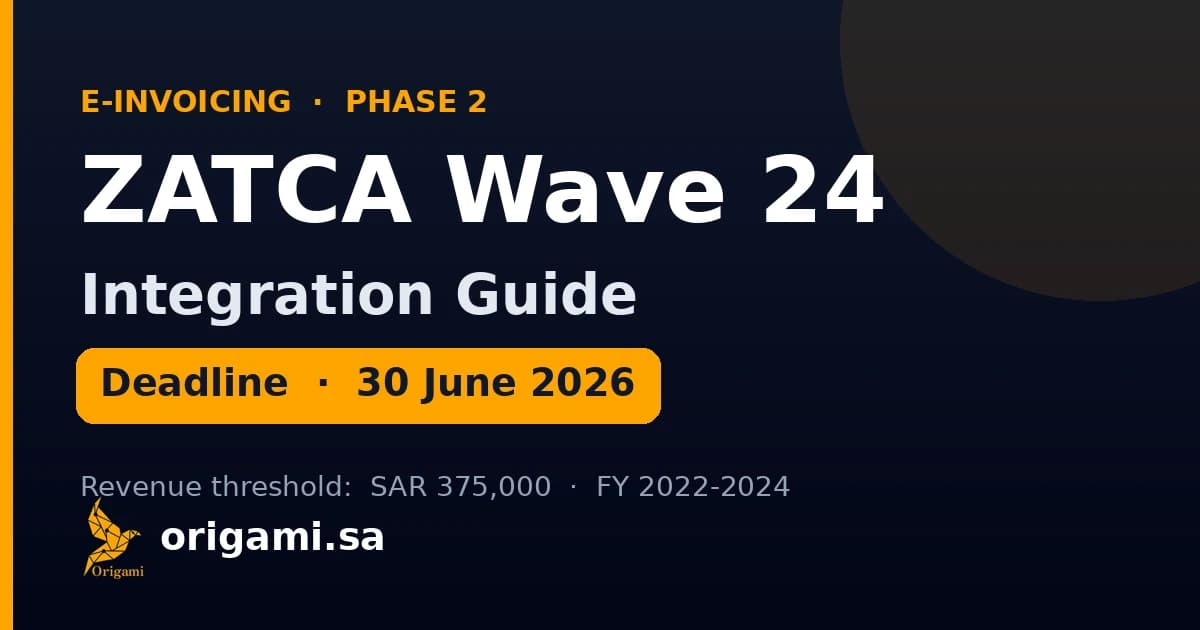
If your VAT-liable revenue exceeded SAR 375,000 during 2022, 2023, or 2024, you fall under Wave 24 of e-invoicing Phase Two, and you must integrate your system with the "Fatoora" platform of the Zakat, Tax and Customs Authority (ZATCA) before June 30, 2026. Integration means issuing invoices in an approved format and transmitting them to the Authority in real time. In this guide we explain who is covered, what is required technically, and how to get ready in the time remaining.
What Is Phase Two (the Integration Phase)?
Phase One of e-invoicing (Generation) began in December 2021 and required businesses to issue electronic invoices instead of paper ones. Phase Two (Integration and Linkage) is a deeper step: it is no longer enough to issue an electronic invoice — your system must integrate directly with the government "Fatoora" platform, so every invoice is sent to the Authority for verification and clearance at the moment it is issued.
This phase is applied in successive waves based on a business's revenue size, from largest to smallest, with each wave having its own compliance deadline.
Who Is Covered in 2026?
- Wave 23: Businesses whose revenue exceeded SAR 750,000 during 2022, 2023, or 2024 — the deadline was March 31, 2026.
- Wave 24: Every business whose VAT-liable revenue exceeded SAR 375,000 during 2022, 2023, or 2024 — the deadline is June 30, 2026.
Wave 24 is the broadest in impact, because the SAR 375,000 threshold captures a large segment of small and medium businesses. If you assume "integration is only for large companies," that perception is no longer accurate.
What Does Integration Require Technically?
Your system needs to be able to:
- Issue invoices in XML format, or PDF/A-3 with embedded XML, per the Authority's specifications.
- Generate a QR code and a cryptographic stamp for each invoice.
- Connect to the "Fatoora" platform via API to submit business (B2B) invoices for prior Clearance, and report consumer (B2C) invoices within 24 hours.
- Obtain a Cryptographic Stamp Identifier (CSID) from the Authority and link it to the system.
These requirements cannot be met manually; you need a compliant accounting system, ERP, or software solution integrated with the Authority.
The Penalty Waiver Window Also Ends June 30, 2026
The Authority extended its "Cancellation of Fines and Exemption of Penalties Initiative" until June 30, 2026 — an opportunity to correct past violations without financial penalties. The coincidence of this window with the Wave 24 deadline makes June 2026 a decisive month for any business that has not yet integrated — and early preparation spares you the last-minute rush.
How to Prepare in the Time Remaining
- Confirm your coverage: Review your VAT-liable revenue across 2022–2024, and await the Authority's official notification.
- Assess your current system: Is your accounting software Phase Two compliant and capable of API integration?
- Prepare your cryptographic certificate (CSID) and the test environment before going live.
- Test ahead of the deadline: Do not leave integration to the last day — format and clearance errors need time to resolve.
How Origami Helps
At Origami we provide Phase Two-compliant e-invoicing integration, whether by embedding the integration into your existing system (ERP or point of sale) or by building a custom solution that meets your business and sector requirements. We handle the complex technical side — the formats, the cryptographic stamp, the CSID certificate, and the integration with the "Fatoora" platform — so you can stay focused on your business.
Frequently Asked Questions
Does Wave 24 include small businesses? Yes, any business whose revenue exceeded SAR 375,000 in any of the years 2022–2024 is covered.
What if I did not receive a notification from the Authority? The Authority notifies targeted businesses, but verifying your coverage and reviewing your revenue is your responsibility — it is best to prepare early.
Do I need to replace my entire accounting system? Not necessarily; sometimes integrating your existing system through a compliant integration is enough, and an assessment determines what fits best.
The June 30, 2026 deadline is approaching, and early preparation is the difference between a smooth integration and a potential violation.
If you want to assess your system's readiness or integrate it with the "Fatoora" platform, book a short call with the Origami team or reach out to us on WhatsApp, and we will outline the most suitable path for your business.
Official Sources
Frequently asked questions
Does Wave 24 include small businesses?
Yes, any business whose VAT-liable revenue exceeded SAR 375,000 in any of the years 2022, 2023, or 2024 is covered by Wave 24.
What if I did not receive a notification from the Authority?
The Authority notifies targeted businesses, but verifying your coverage and reviewing your revenue is your responsibility — it is best to prepare early, ahead of the June 30, 2026 deadline.
Do I need to replace my entire accounting system?
Not necessarily; sometimes integrating your existing system through a Phase Two-compliant integration is enough, and an assessment determines what fits your business best.
Follow Origami in Google
Pin Origami as a preferred source and our articles will surface first for you in Google Search and Top Stories.